

You might have heard that frogs lay a LOT of eggs. That’s true. But do you know how many eggs frogs lay? Or why they lay so many? Read on to find out…
How many eggs do frogs lay? Female frogs lay thousands of eggs. Depending on the frog and its species, the number can range from 2,000 to 20,000 eggs.
Why do frogs lay so many eggs?
The first reason for that is the fact that other animals see the eggs as food and gladly feast themselves on those eggs. This is why you won’t see much frogspawn in ponds with fish.
The second reason is the fact that those eggs aren’t protected from the sun by anything. Normally (when you look at birds for example) the eggs have a strong layer of protection.
Frogs don’t have that. This means that when the frog eggs aren’t laying in water, the sun will dry up those eggs and the tadpoles inside will die.
With all these things that could go wrong with the eggs, there aren’t many that will survive. A rough estimate is that only 1 in 50 eggs will survive and will grow from an egg into a tadpole.
To put this into perspective… When a female frog lays 20,000 eggs and all of them get fertilized, only about 400 of them will grow into tadpoles.
But, this doesn’t necessarily mean that there are going to be 400 frogs. Frogs are, in various stages of their lives a prey for other animals. So chances are that other animals will eat many of the tadpoles that are in the pond in the weeks that it grows into a young frog.

How Do Frogs Lay Eggs?
The process begins with amplexus, where the male clasps the female tightly. As the female lays eggs, the male releases sperm over them, fertilizing externally. Eggs are encased in a jelly‑like coating that:
- Keeps them moist.
- Provides some protection against predators.
- Allows oxygen exchange.
Depending on species, eggs hatch within days to weeks, releasing tadpoles that begin their aquatic life before metamorphosis.
Species‑Wise Egg Laying
- American Bullfrog (Lithobates catesbeianus): Can lay up to 20,000 eggs in large floating masses.
- Leopard Frog (Lithobates pipiens): Lays hundreds to thousands of eggs in clusters attached to vegetation.
- Red‑Eyed Tree Frog (Agalychnis callidryas):Lays 30–50 eggs on leaves above water, relying on gravity for tadpole survival.
- Poison Dart Frogs (Dendrobates spp.): Lay small clutches of 2–6 eggs in leaf litter; parents often transport tadpoles to water.
- Surinam Toad (Pipa pipa): Lays dozens of eggs that embed in the female’s back until tadpoles emerge.
- Darwin’s Frog (Rhinoderma darwinii): Lays small clutches, with males incubating tadpoles in their vocal sacs.
- White’s Tree Frog (Litoria caerulea): Lays hundreds of eggs in water, forming jelly‑like clusters.
- Pacman Frog (Ceratophrys ornata): Lays hundreds to thousands of eggs in shallow water, often in temporary pools.
Where Do Frogs Lay Eggs?
Most frogs lay eggs in water bodies such as ponds, lakes, streams, or temporary rain pools. However, some species have evolved unique strategies:
- Leaf nests: Tropical frogs like Red‑Eyed Tree Frogs lay eggs on leaves above water. When tadpoles hatch, they drop into the pond below.
- Foam nests: Certain species whip their eggs into frothy foam masses that float on water.
- Burrowed soil or hidden crevices: Some frogs lay eggs underground or in moist soil to protect them from predators.
- On the body: Rare species like the Surinam Toad embed eggs in their back skin, while Darwin’s Frog males carry tadpoles in their vocal sacs.

So, why do frogs release such a large number of eggs? Frogs release a large number of eggs to make the chance of producing offspring greater. Fertilization happens outside of the female frog. That means that the chance of the eggs surviving is small. Other animals can eat the eggs or when the eggs aren’t getting any water they will dry up and die. By laying lots of eggs, it’s more likely that some will survive.
Why do frogs lay their eggs in water?
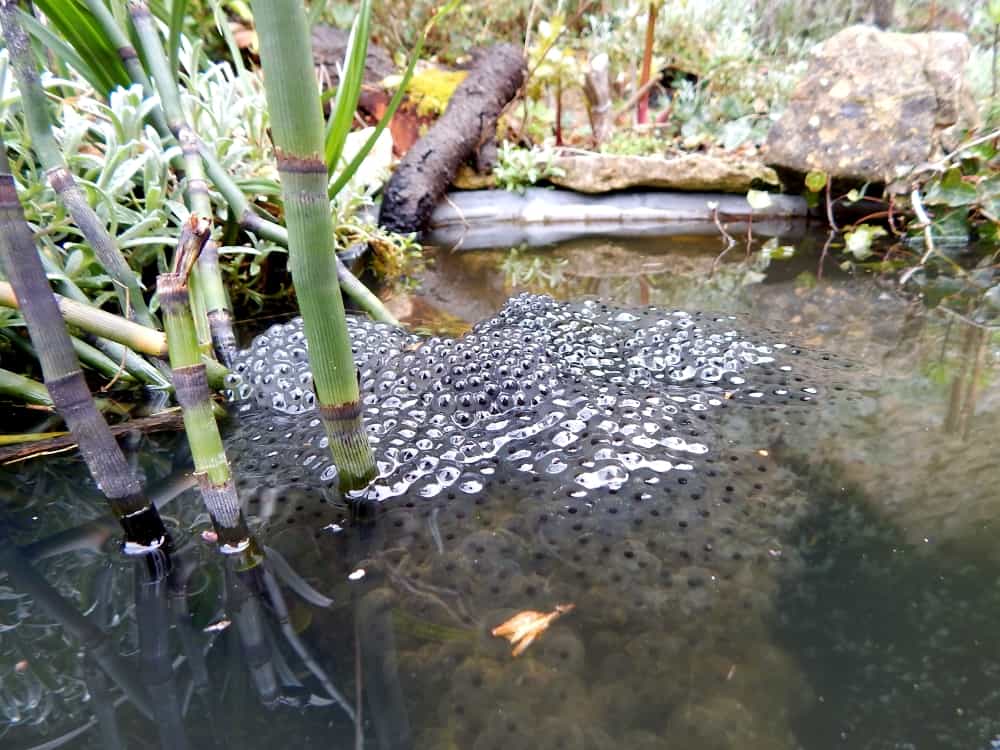
I think all of us have seen some frogspawn from time to time and the thing to notice is that it looks and feels jelly. This means that the eggs of frogs don’t have a hard protective layer over their eggs as birds and reptile eggs do.
Now, this is exactly the reason why they lay their eggs in water. You see, when they don’t do that, the eggs will dry up, and then the very tiny tadpoles inside will die.
The best spots for frogs to lay eggs
Ponds
The frogspawn of females is usually found in well-vegetated, shaded, and shallow ponds. But it is worth to mention that, if you want to find some frog eggs, you should avoid the ponds with fish in them. Normally you wouldn’t find many frogs there because the fish could eat the frogspawn.
Drainage
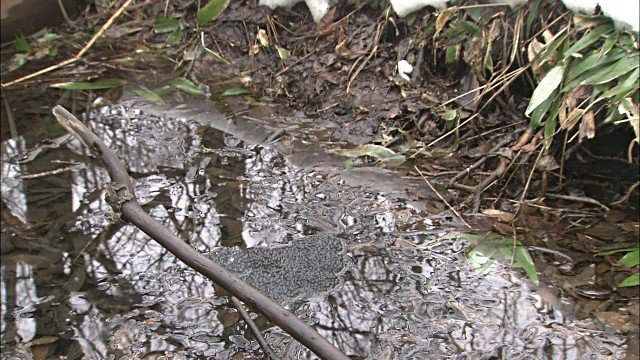
Frogs can also use a drainage ditch to lay their eggs. Especially after warm rains. So, if you want to find eggs in a drainage ditch, go outside after warm rains and look and search the water for eggs.

Water from raining
As I stated above, frogs like to breed after warm rains. This does not only mean that you can find eggs in drainage ditches or ponds but also in a puddle of water.
But most lay their eggs and attach them to submerging vegetation near the edge of the body of water.
Related Questions
1. How many eggs do frogs lay? Most frogs lay hundreds to thousands of eggs at a time. The exact number depends on the species. For example, American Bullfrogs can lay up to 20,000 eggs, while smaller frogs may lay only a few hundred.
2. Why do frogs lay so many eggs? Frogs lay large numbers of eggs because survival rates are low. Many eggs and tadpoles are eaten by predators or fail to develop, so producing thousands increases the chance that some will reach adulthood.
3. Do all frog species lay eggs in water? Most frogs lay eggs in ponds, streams, or temporary pools, but some species lay eggs on leaves above water, in foam nests, or even carry them on their backs.
4. How often do frogs lay eggs? Typically once per breeding season, though tropical species may breed multiple times a year depending on rainfall and climate.
5. Are frog eggs fertilized internally or externally? Frogs use external fertilization. The male clasps the female in amplexus and fertilizes the eggs as she lays them.
6. How long does it take frog eggs to hatch? Depending on species and temperature, eggs hatch in a few days to several weeks.
7. Do all frog eggs survive? No. Most eggs are eaten by fish, insects, or other frogs. Only a small fraction survive to become tadpoles and eventually adult frogs.
8. Why are frog eggs jelly‑like? The jelly coating protects the eggs from drying out and provides some defense against predators.
9. Do frogs ever give live birth? Rarely. Almost all frogs lay eggs, but a few unusual species (like the Nimba Toad) have evolved unique reproductive strategies.
10. What happens if frog eggs dry out? They usually die. Moisture is critical for frog egg survival, which is why humidity and water access are essential.

Hi, I’m Mike, and I’m the creator of amphibianlife.com. If there was one word to describe it? It would be: passionate about Amphibians! Whether you want to know more about amphibians or have a presentation to give at school, you’ve come to the right place.